Product Designer
14-Month Engagement
Commercial Business Banking
Employee-Facing Tools
Customer-Facing Experience
Legacy System Migration
Design System Development
Dashboard
(Monitoring & Insights)
Approval Flow
(High-Risk Transactions)
Exception Processing (Returns & Errors)
Challenge
Business users managing high-value EFT transactions struggled to identify and act on failed or partially processed payments within a fragmented legacy system.
Critical transaction errors were buried in large system-generated reports, forcing manual reconciliation across thousands of records. This delayed the detection of time-sensitive financial exceptions, increased operational risk, and added significant cognitive load to already complex, multi-step approval workflows.
These challenges were compounded by strict technical constraints, including file-based processing, limited real-time data rendering, and rigid approval structures.
Opportunity
How might we enable business users to quickly identify and act on critical EFT transaction outcomes within a constrained legacy system, reducing risk and cognitive load in high-stakes financial workflows?

Solution
I reframed the system from a transaction-processing interface into an exception-driven operational tool, prioritizing visibility, clarity, and informed decision-making.
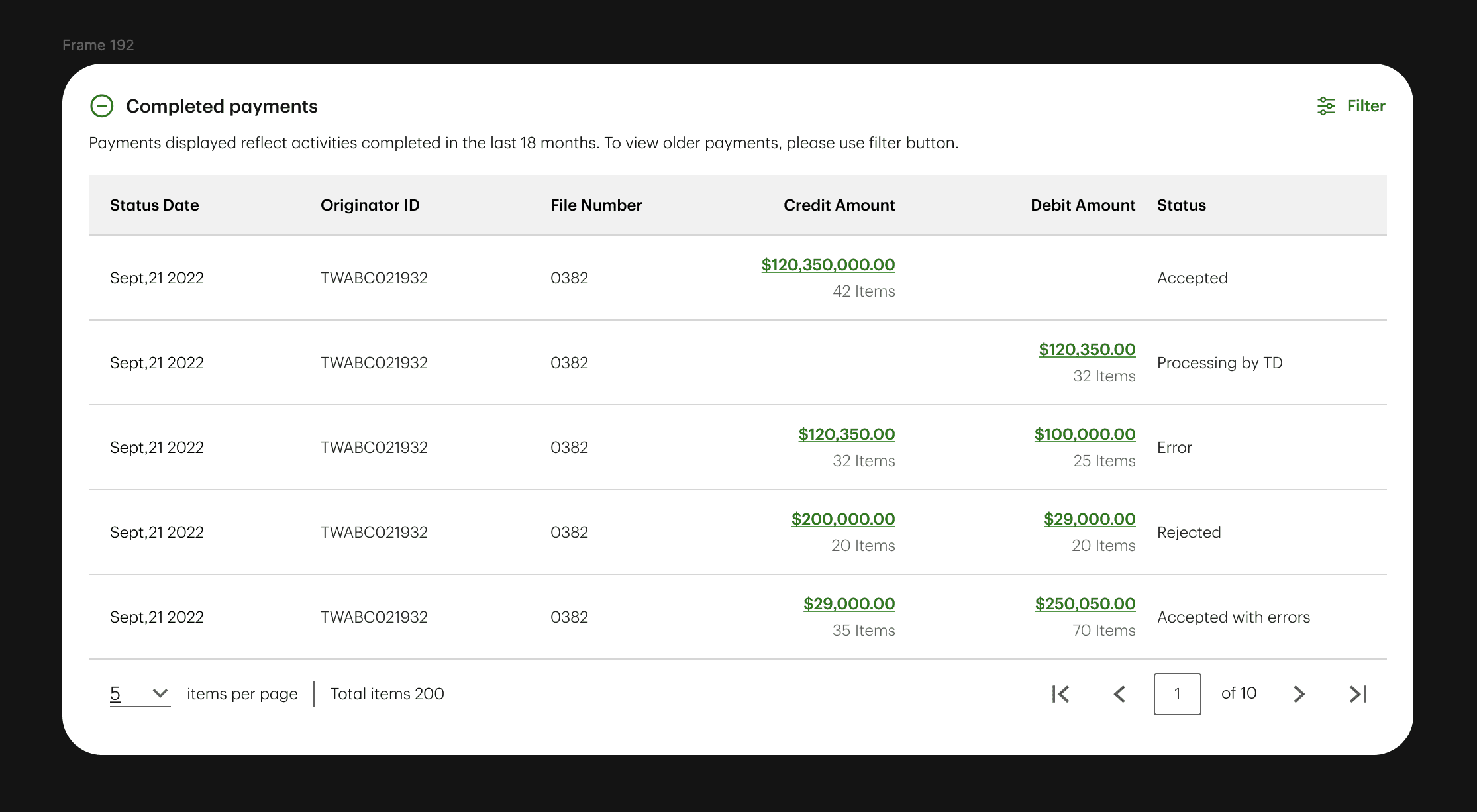
Alert-First Architecture: Elevated failed transactions (Returns) to the top of the dashboard, transforming hidden report data into immediate, actionable insights
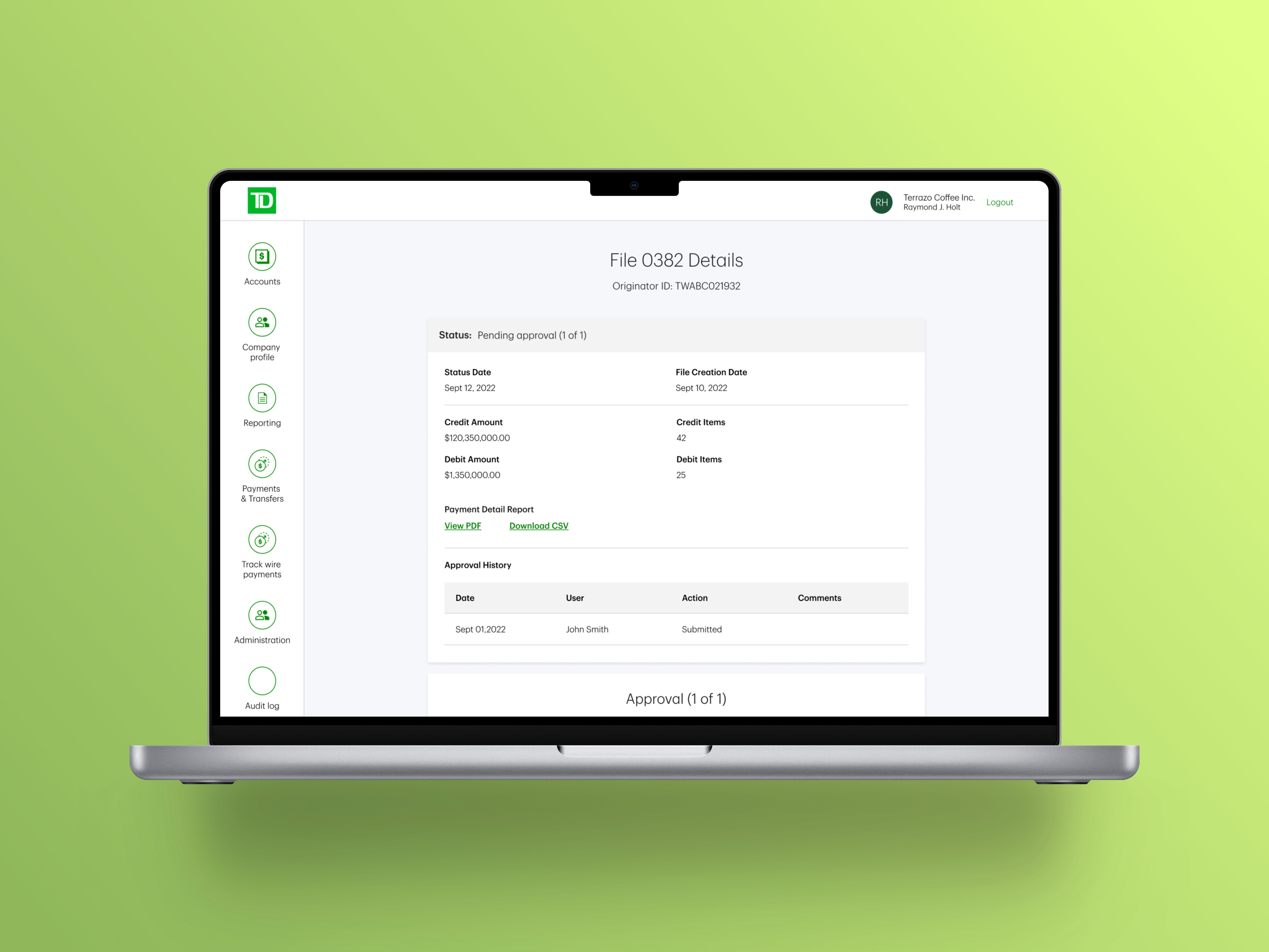
Positive Friction in Approvals: Introduced a focused, full-page review experience and multi-step approval flow to reduce errors in high-value transfers
Clear Status Mapping: Translated complex backend states into intuitive, scannable UI signals, enabling users to quickly understand transaction outcomes
Workflow-Aligned Outputs: Integrated CSV/PDF exports and structured summaries to support reconciliation and external accounting workflows
By shifting from passive reporting to proactive visibility, the design reduced time-to-action, improved operational response to financial exceptions, and made a legacy-constrained system feel predictable and controllable.

Scaling the Solution: Design System Initiative
While working on the EFT workflow, I identified a broader platform-level issue.
The business banking migration introduced multiple UI frameworks that were not aligned with existing systems like TD Emerald Design System and TD Odyssey Design System, creating a fragmented experience across products.
At the same time, multiple design pods were working in parallel without a shared design foundation.
My Initiative
Although my role focused on EFT, I took ownership of creating a unified design layer to bridge design and engineering:
Built a Figma component library based on the developer UI framework
Aligned visual foundations (color, typography, spacing) with Emerald branding
Translated engineering components into reusable design patterns
Standardized interaction behaviors across workflows
Cross-Team Impact
Established a single source of truth for multiple design pods
Reduced design inconsistencies and duplicated effort
Improved designer–developer alignment using shared components
Accelerated development by minimizing rework
Created a more cohesive user experience during platform migration

“ Consistency in enterprise systems is not just a visual decision—it is a scalability and trust strategy. ”
Design Leadership Insight
Impact
Reduced Time-to-Action: Transformed failed transaction detection from manual report searching into immediate dashboard visibility
Mitigated Financial Risk: Introduced structured review and approval flows to support high-value decision-making
Improved Operational Efficiency: Reduced cognitive load by making transaction states clear and actionable
Enabled Cross-Team Scalability: Created a shared design system that streamlined collaboration and accelerated delivery across pods
Enhanced Platform Consistency: Reduced fragmentation during migration, improving overall user experience